
Review · RIO WALKING TOURS
Rio’s city walking tour: a glimpse of history and olympic legacy
Rio’s downtown tells a different story from the beach neighborhoods. This walking tour takes you past gilt-covered churches, imperial buildings, old squares, market streets, Olympic-era museums, and the immense Metropolitan Cathedral. It is a useful way to get your bearings fast while seeing parts of Rio you might skip on your own.
I especially like the stop at São Bento Monastery, where the plain exterior gives little warning of the gold, paintings, and carved wood inside. I also like the mix of old and new: Mauá Square, the Museum of Tomorrow, and the Cobra murals bring Rio’s recent Olympic renewal into the same afternoon as Paço Imperial and Praça XV.
The main consideration is pace and transport. You may walk briskly, and traffic can eat into sightseeing time. The tour is advertised at about four hours, but the exact experience can change with traffic, group size, opening conditions, and the guide.
Key points to know before booking
- São Bento Monastery is the artistic high point: Its interior, paintings, and gilt carvings are the reason to bring this tour to the top of your list.
- The route covers old and new Rio: You see imperial squares and Portuguese-style buildings alongside Mauá Square and the Museum of Tomorrow.
- Hotel pickup is included: Service covers most hotels in São Conrado, Leblon, Ipanema, and Copacabana.
- Guide quality matters: Guides named in the feedback include JB, also called Juan Bautista, Melanie, Malenia, and André.
- The tour can become partly private: The maximum group size is 35, but small bookings have allowed guides to adjust the route to personal interests.
- Plan for walking: You need a moderate level of fitness, and some people found the pace brisk.
Why downtown Rio deserves an afternoon
Rio is often sold through Sugarloaf Mountain, Christ the Redeemer, Copacabana, and Ipanema. Those sights are worthwhile, but they do not explain how the city was governed, built, worshipped in, and reshaped.
This tour focuses on the center, where colonial beginnings, Portuguese rule, the Brazilian Empire, and modern cultural projects sit close together. The setting is not polished at every turn. You pass market streets, busy roads, old façades, and ordinary city life. That is part of the value. You see Rio as a working city, not just a postcard.
The route is also useful early in a trip. A first or second day on this walk can help you understand the downtown layout and identify places you may want to revisit on your own. Guides have also given practical suggestions about local markets, food, transport, and places to spend more time.
The tour starts at 1 p.m., making it a practical choice after a morning at your hotel or after an earlier major attraction. Pickup is offered from most hotels in the main southern beach districts. Confirm your hotel location carefully, since coverage is stated by neighborhood rather than every hotel in the city.
More walking tours in Rio de Janeiro:
- Rio de Janeiro: Rocinha Favela Walking Tour with Local Guide
★ 4.8 · 3,052 reviews - Rio De Janeiro: Half-Day Rocinha Favela Walking Tour
★ 4.7 · 2,272 reviews - Sunrise and Sunrise Walk Two Brothers with Local Guide
★ 5.0 · 193 reviews
Candelária Church: a grand opening scene
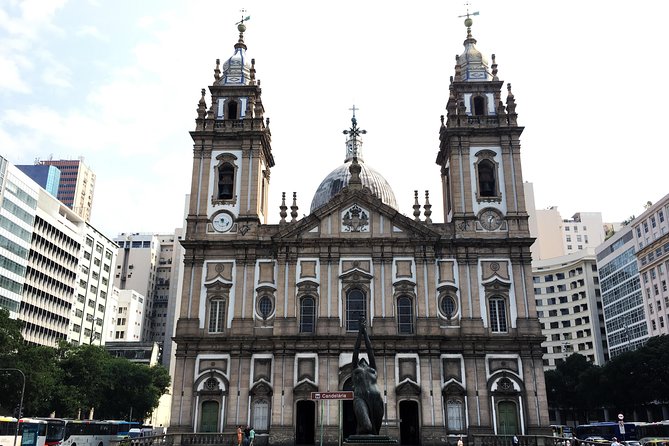
The Church of Our Lady of Candelária, or Nossa Senhora da Candelária, is one of the first major stops. Construction began in 1630 and was completed in 1775. Its neoclassical design gives the building a formal, European look that contrasts with the busy streets around it.
The visit is listed at about 10 minutes and admission is free. That is enough time to see the main interior and hear the basic story, but not enough for a slow architectural study. If you care about church art, stay close to the guide and ask questions while the group is inside.
This stop helps set the tone for the afternoon. Rio’s center is not one continuous colonial quarter. Instead, different periods appear beside one another. Candelária shows the scale and ambition of religious architecture during Portuguese rule, while the surrounding streets remind you that this is still a busy modern center.
São Bento Monastery: the tour’s strongest interior
São Bento Monastery is the place I would most want to see on this route. Founded in 1590 by two monks from Bahia, it is regarded as an important example of Brazilian architecture. Its exterior is restrained, but the interior is famous for paintings, carved details, and extensive gilding.
The listed visit is about 10 minutes, so expect an introduction rather than a long, quiet examination. Still, the short stop can be memorable because the decoration is concentrated and dramatic. Several people singled out the Benedictine chapel and its artwork as a major highlight.
One useful detail is the view from the monastery. A guide named JB pointed out that you can sometimes see the Museum of Tomorrow from there, creating an unusual view across different eras of Rio. This is exactly the kind of connection that makes a guide valuable. You are not only looking at a church. You are seeing how old and new Rio occupy the same city.
Keep in mind that religious sites may have their own visiting conditions. The tour information says admission is free, but it does not promise unlimited time inside or a particular interior viewing schedule.
Mauá Square and Rio’s Olympic-era renewal
The route then shifts toward Mauá Square, one of the clearest examples of Rio’s recent urban change. The square was renewed as part of the Olympic legacy and became a center for museums, art, public space, and large murals.
You may see the Rio Art Museum, the Museum of Tomorrow, and the famous Cobra murals. The Cobra work is especially easy to appreciate outdoors, since it gives the area a strong visual identity without requiring a long indoor visit.
The Museum of Tomorrow is presented as a modern landmark rather than a full museum visit. That distinction matters. You should expect to see the building and hear about its place in the redeveloped port area, not automatically assume that a museum ticket or extended gallery time is included.
One guide arranged a shuttle ride around the Museum of Tomorrow for the group. That was a helpful solution for people who wanted a closer look without adding too much walking, but it should be treated as a guide-dependent extra rather than a guaranteed part of the package.
This part of the tour gives the afternoon a welcome change of rhythm. After churches and imperial buildings, the open square, contemporary museums, and public art show a newer side of Rio.
More history tours in Rio de Janeiro:
- Rio de Janeiro: Historic Rio and Santa Teresa Half-Day Tour
★ 4.4 · 228 reviews - Rio de Janeiro: Little Africa Heritage Walking Tour
★ 4.9 · 177 reviews - Explore Little Africa : Unveiling Afro Heritage in Rio de Janeiro
★ 5.0 · 97 reviews - Learn the History of Rio with an Unforgettable City Center Walking Tour
★ 5.0 · 82 reviews
Praça XV and Paço Imperial: where power once gathered
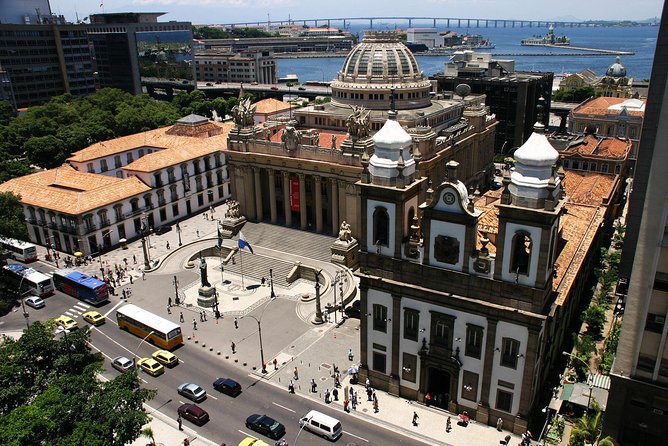
Praça XV do Novembro is one of the key historical spaces on the route. Brazil’s emperors were crowned here in the 1800s, and important political events took place in the square. A good guide can turn what first looks like an open urban space into a useful map of Brazilian power.
Near the square is Paço Imperial, built in the 1700s as a residence and workplace for the governors of the captaincy. It later served as a residence of the Portuguese Royal Family when it arrived in Brazil.
The building’s Portuguese style makes it easy to connect Rio with the wider history of the Portuguese empire. This is also a place where the guide’s commentary matters more than the amount of time spent taking photographs. Ask how the building’s role changed as Brazil moved from colonial rule to monarchy.
The tour passes rather than promises a long formal visit at several historic sites. If you want to enter every building, study every plaque, or take a full museum tour, four hours will feel short. If you want a clear introduction to the city’s political past, the route works well.
Market streets, Tiradentes Palace, and everyday downtown
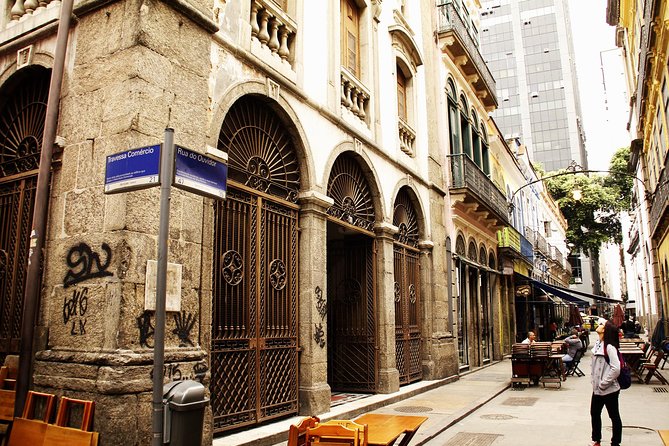
Between the major monuments, you pass through famous market streets in central Rio. These sections are important because they break up the grand architecture with daily city life. You see where people shop and move through the center, rather than staying inside a sequence of formal attractions.
The guide also points out Tiradentes Palace from the outside. Since this is an exterior stop, your experience depends on the explanation and the view available from the street.
Some people want more time to browse and take in these ordinary streets. That is a fair request. One criticism of the tour was that traffic and driving reduced the walking time. On a day with heavy traffic, the route can feel less like a continuous stroll and more like a sightseeing transfer with walks between stops.
If you prefer a slower street tour, tell the guide early. Guides such as JB, Melanie, and André have been described as flexible, and small groups have allowed them to adjust the time spent at different places. That flexibility is less certain in a large group of up to 35 people.
Confeitaria Colombo: a graceful pause
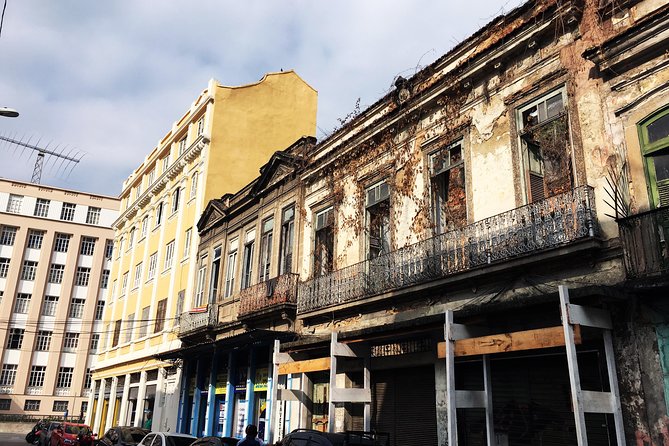
Confeitaria Colombo is listed as a 20-minute stop. This famous bakery is an attractive historic setting and a natural pause in the middle of the route.
Food and drinks are not included, so budget separately if you want to order something. The short visit may be enough to see the interior and take a break, but it is not a full meal stop. One point of criticism was that about 30 minutes in a tea shop reduced time at other sights. That is useful to keep in mind if your priority is monuments rather than café atmosphere.
I would treat Colombo as a bonus, not the main reason to book. It adds texture to the day and gives you a chance to sit or look around, but the churches and historic squares carry more of the tour’s substance.
Uruguaiana Street and the final cathedral
The route continues along Uruguaiana Street toward Carioca Square and the Metropolitan Cathedral. Uruguaiana is one of the market streets that gives you a feel for downtown commerce.
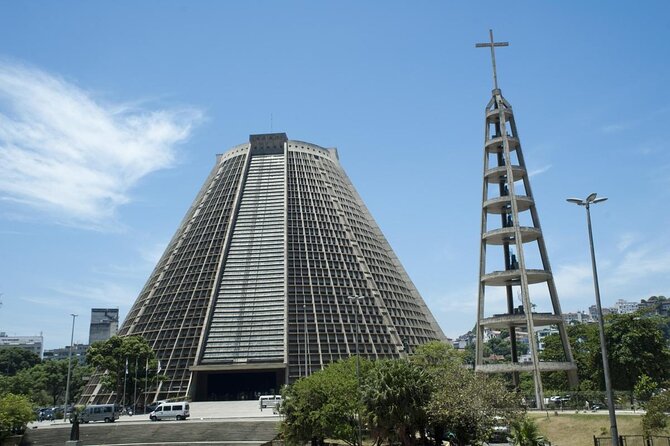
The Metropolitan Cathedral of Saint Sebastian is unlike the older churches on the route. Its conical form is vast, with an internal diameter of about 96 meters, an external diameter of about 106 meters, and an overall height of about 75 meters. The scale can be startling after the intimate ornament of São Bento.
The cathedral visit is listed at about 10 minutes. That is enough to enter, look upward, and hear the main facts, but you may want to return later if you care about the structure and its interior details.
The supplied route information says the tour concludes in the Carioca Square area, while the main description also places the Metropolitan Cathedral near the end. In practical terms, be ready for the formal tour to finish in central Rio rather than at your hotel. Hotel return is included for the covered pickup areas, but confirm the exact drop-off plan when you book or meet the guide.
Guides, pace, and group size
The guide can shape this experience more than any single building. JB, short for Juan Bautista, received especially strong praise for his energy, clear English, passion for Rio, and ability to explain sites during the ride as well as on foot. Melanie, also identified in one comment as Malenia, was described as friendly and easygoing, with the ability to move between Spanish and English while caring for different people in the group. André was praised for arriving on time, answering questions, and adapting the route.
Those names do not guarantee who you will receive. They do show the kind of guide who makes this tour work best: someone who can connect architecture, politics, city layout, and practical advice.
The group maximum is 35. In reality, bookings can be much smaller, and some departures have become private or nearly private. That can make the route flexible. A guide may spend more time on a church you like or avoid a place you already visited.
The downside is inconsistency. One poor experience involved a guide who spent much of the walk on a phone and rushed through the checklist. Another departure suffered from confusion over the pickup hotel and time. These problems appear to be exceptions rather than the usual pattern, but they are worth allowing for when you choose a third-party tour.
Is $60.77 a fair price?
At $60.77 per person, this is not the cheapest way to see central Rio. You are paying for hotel pickup, a guide, transport connections, and a planned route through several parts of downtown.
The price makes better sense if you are staying in Copacabana, Ipanema, Leblon, or São Conrado and want someone else to handle the first transfer into the center. It also has value if you want context instead of simply walking past façades with no explanation.
It is less appealing if you are comfortable using public transport, already know downtown, or mainly want long visits inside museums. Several key stops are brief, food and drinks cost extra, and traffic can reduce the walking time.
The strongest value comes when the group is small and the guide is engaged. In that situation, the tour can function like a private introduction to Rio’s center, with room for questions and local suggestions.
Who should book this walking tour?
I would recommend it to first-time visitors who want a clear introduction to downtown Rio, especially people interested in churches, architecture, Brazilian political history, and the city’s Olympic-era changes.
It also suits you if you want hotel pickup and prefer not to work out the route alone. The mix of walking and short transfers is useful for seeing a broad area in one afternoon.
You should think twice if you dislike brisk walking, want extensive free time, or are mainly interested in modern museums. The tour requires moderate fitness, and the listed visits are short. The center can also be hot, crowded, and affected by traffic, so bring water and comfortable shoes even though those items are not stated as inclusions.
Free cancellation is available up to 24 hours before the start time. Poor weather or an insufficient number of bookings can also lead to a new date, another experience, or a full refund.
Should you book it?
Book this tour if you want the big picture of old Rio in one organized afternoon. São Bento Monastery, Candelária Church, Praça XV, Paço Imperial, Mauá Square, Confeitaria Colombo, and the Metropolitan Cathedral give you a broad introduction without requiring several separate outings.
I would book it early in your Rio stay and use the guide for follow-up ideas. Just keep your expectations sensible: this is a brisk orientation, not a slow museum day. The best version includes a small group, a flexible guide such as JB, Melanie, André, or another engaged local, and enough time to walk rather than sit in traffic.
FAQ
How long does the tour last?
The tour lasts approximately four hours.
What time does the tour begin?
The listed start time is 1:00 p.m.
Is hotel pickup included?
Yes. Pickup and drop-off are included for most hotels in São Conrado, Leblon, Ipanema, and Copacabana.
What sites are included?
The route includes Candelária Church, São Bento Monastery, Mauá Square, the Museum of Tomorrow area, Praça XV do Novembro, Paço Imperial, market streets, Tiradentes Palace from the outside, Confeitaria Colombo, and the Metropolitan Cathedral.
Are entrance tickets included?
The listed visits to Candelária Church, São Bento Monastery, Confeitaria Colombo, and the Metropolitan Cathedral show free admission. Food, drinks, and any paid museum entry are not included.
How large can the group be?
The maximum group size is 35 people.
How much walking is involved?
You need a moderate level of physical fitness. The experience includes walking through downtown streets, and some departures may move at a brisk pace.
Can I cancel for a refund?
You can cancel up to 24 hours before the experience for a full refund. Cancellations or changes made less than 24 hours before the start time are not accepted for a refund.
What happens if the tour is canceled?
If poor weather or too few bookings cause a cancellation, you are offered a different date or experience, or a full refund.
Just added around Rio de Janeiro
- Vidigal Favela Tour★ 4.4 · 26 reviews
- Hang gliding flight in Rio de Janeiro★ 5.0 · 6 reviews
- Rio de Janeiro: Zip Lining and Canopy Tree Tour★ 3.3 · 6 reviews
- Tijuca Forest Hike – Waterfalls & Caves, Nature & Wild Life!★ 5.0 · 51 reviews
- Unforgettable Boat Party★ 5.0 · 3 reviews
- Guided Tour to Favela Santa Marta★ 5.0 · 60 reviews
- Rio de Janeiro: Attend a Vasco da Gama game with local guide★ 4.8 · 9 reviews
- Rio Highlights: Christ, Sugarloaf, and More in a Private Tour★ 5.0 · 36 reviews
Rio Walking Tours, compared.



Sunrise and Sunrise Walk Two Brothers with Local Guide
Read our review →
Learn the History of Rio with an Unforgettable City Center Walking Tour
Read our review →
Walking tour of the bohemian neighborhoods of Santa Teresa and Lapa
Read our review →
Browse the lists this tour appears in