
Review · GUANABARA BAY CRUISES
Rio From the Sea: Guanabara Bay Cruise with Optional Barbecue Lunch
Rio is most dramatic from the water. This Guanabara Bay cruise gives you broad views of Sugarloaf Mountain, Christ the Redeemer, Copacabana, Niterói, and the city’s waterfront without the traffic and hills. I like the relaxed pace and the chance to see famous sights from angles you cannot get on land.
I also like the hotel pickup and the lively commentary, especially when guides such as Luis, Louis, DJ, and JB are leading the day. The main caution is the lunch upgrade: it is described as an all-you-can-eat barbecue, but some bookings have been sold as seafood and delivered as a standard barbecue meal.
Key points to know
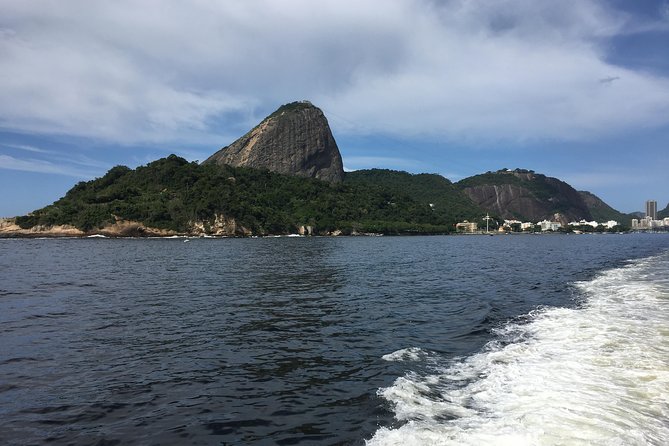
- Sugarloaf from the bay: The mountain looks especially striking from the water, with Urca and Botafogo spread around it.
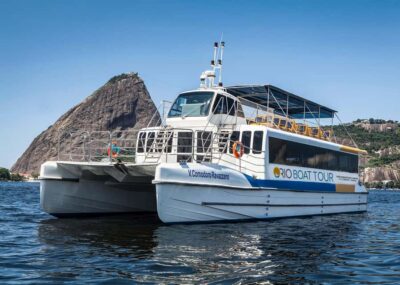
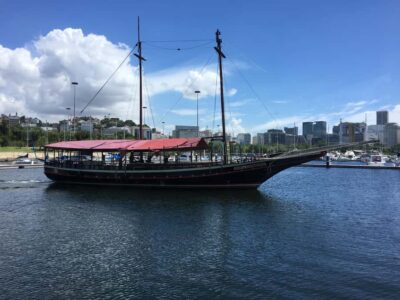
- A two-hour schooner cruise: The boat ride is long enough to see a lot without taking up a full day.
- Historic and modern Rio together: You pass Ilha Fiscal, old forts, the Museum of Tomorrow, the Rio-Niterói Bridge, and Niemeyer’s museum.
- South Zone pickup included: Pickup and return are available from most hotels in São Conrado, Leblon, Ipanema, and Copacabana.
- Lunch needs clarification: The optional meal is a Brazilian barbecue at a local restaurant, not reliably a seafood buffet.
- Weather matters: Poor conditions can lead to a new date or a full refund.
What the Guanabara Bay cruise is really like
This is a sightseeing cruise, not a beach outing. You remain on the schooner for the bay ride, with no scheduled swimming stop or beach visit.
That distinction matters. Some descriptions of Rio boat trips can sound like a day on the water with time to swim. Here, the attraction is the view: the city’s hills, beaches, forts, bridges, museums, airports, and neighborhoods line up from a calm vantage point.
The experience usually lasts four to six hours from hotel pickup to return, with about two hours on the boat. The launch point is Marina da Glória, and departure is scheduled for around 9:30 in the morning. The tour is listed for a maximum of 20 people, though the schooner itself may feel less intimate than a small private boat.
I would treat this as a gentle introduction to Rio’s geography. You are not stopping to explore each place. Instead, you get a moving panorama and enough commentary to understand how Guanabara Bay connects Rio de Janeiro and Niterói.
More Guanabara Bay cruises:
- Rio de Janeiro: Guanabara Bay Sunset Sailing Tour & Drinks
★ 4.9 · 331 reviews - Rio: Boat Tour of Guanabara Bay
★ 4.4 · 214 reviews - Rio From The Sea: Guanabara Bay Cruise with Optional Lunch
★ 3.3 · 36 reviews
Marina da Glória and the first views of Rio
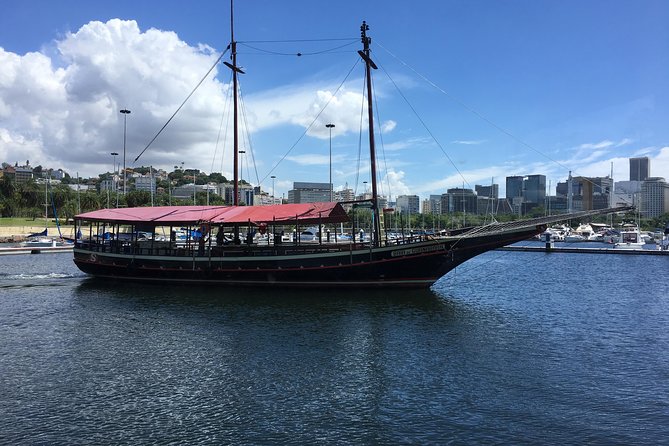
After pickup, you reach Marina da Glória, a useful starting point because it places you close to the city center and the bay. The boat leaves from the pier, and the first minutes are spent getting clear of the urban shoreline.
This early section gives you a helpful overview. Rio’s crowded roads, towers, parks, and steep hills begin to make more sense when viewed from the water. The city looks less tangled from here, and you can see how the South Zone, downtown, and the bay fit together.
The boat ride is made by schooner and usually takes about two hours. Conditions on the bay affect the speed, so do not plan a tight connection immediately afterward. One booking returned to the hotel later than expected because the wrong boat was initially sent to the dock, although the guide worked to shorten the delay.
The best guides add real value here. Luis and Louis were praised for staying attentive and helping with photographs, while DJ and JB were noted for mixing humor with useful background. Commentary can be harder to hear when the boat is crowded or noisy, so a guide who walks around and explains sights personally is a real advantage.
Airport views, Ilha Fiscal, and downtown history
As the boat moves along the bay, you may pass near Rio’s airport. This is an unusual part of the route, since you can sometimes watch aircraft taking off or landing close to the water.
The airport view is not one of Rio’s classic postcard scenes, but it adds variety. It also shows how tightly the city’s transport systems fit around Guanabara Bay.
Ilha Fiscal is more distinctive. Once called Ilha dos Ratos by European visitors, the island later became associated with Brazil’s imperial era. It hosted the famous final grand ball of the Empire before the 1889 coup that established the Republic.
Today, Ilha Fiscal houses a cultural history museum maintained by the Brazilian Navy. You see it from the boat rather than touring the interior, but the island gives the cruise a historical layer beyond beaches and mountain views.
Downtown Rio comes next, with large buildings and broad avenues viewed without street noise or traffic. From the bay, the city’s scale is easier to appreciate. This is also a good point to listen closely to the guide, since the waterfront includes several landmarks that can blur together without explanation.
Churches, Pier Mauá, and the Museum of Tomorrow
The route includes a view of an important Roman Catholic church built over a long period from 1775 into the late 19th century. Its exterior reflects Portuguese colonial Baroque design, while the interior includes later Neoclassical and Neo-Renaissance elements.
You will not be getting off to inspect the architecture, so this stop works best as a quick visual reference. Still, it helps show the range of Rio’s built environment, from colonial religious buildings to modern museums.
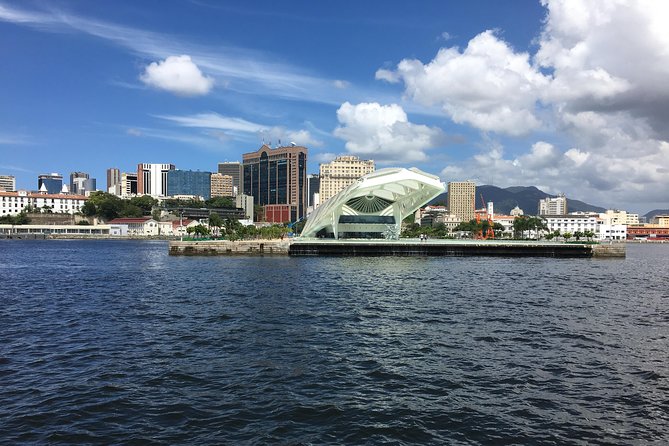
At Pier Mauá, the Museum of Tomorrow brings a sharp change in style. Designed by Spanish architect Santiago Calatrava, the science museum has a futuristic form beside the waterfront. Seeing it from the bay gives you a clean view of the structure and its setting.
I like this contrast. Within a short stretch, you can look from imperial-era landmarks to one of Rio’s most modern public buildings. The cruise is strongest when it presents those changes in sequence.
More boat trips from Rio de Janeiro:
- Rio de Janeiro: Sunset Sailing Tour
★ 4.8 · 994 reviews - From Rio de Janeiro: Angra dos Reis Boat Trip with Lunch
★ 4.0 · 737 reviews - From Rio: Arraial do Cabo Day Trip with Boat Tour
★ 3.8 · 400 reviews - Arraial do Cabo Day Trip from Rio de Janeiro: Boat Tour & Beach
★ 4.5 · 390 reviews
Under the Rio-Niterói Bridge to Oscar Niemeyer’s museum
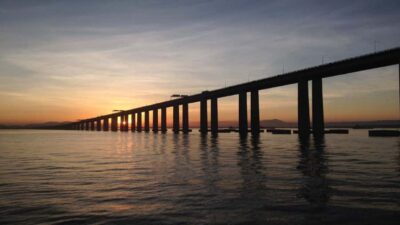
One of the route’s more memorable moments is passing beneath the President Costa e Silva Bridge, commonly called the Rio-Niterói Bridge. It links Rio de Janeiro with Niterói and crosses a large part of the bay.
From below, the bridge is less pretty than the famous mountains, but it gives you a sense of the bay’s size and importance. It is also a good reminder that Guanabara Bay is a working waterway, not simply a scenic backdrop.
On the Niterói side, you see beaches and the distinctive Contemporary Art Museum designed by Oscar Niemeyer. Completed in 1996, the museum resembles a saucer perched above the shore. Its shape is easier to recognize from the water than from a passing road.
This portion can feel more industrial than the Rio shoreline. If your ideal boat ride is nonstop tropical scenery, you may find the bridge, port areas, and working waterfront less appealing. I see that as part of the tradeoff: the cruise shows the whole bay, not just its prettiest corner.
Fortaleza Santa Cruz and the bay’s military past
Fortaleza Santa Cruz is one of the route’s main historic sights. Located in Niterói, the fort guards the entrance to Guanabara Bay and gives the waterway a strong military context.
The boat provides a broad view of the fort rather than a full visit. You can appreciate its position on the shoreline and understand why this entrance was strategically important, but you will not have time to inspect its rooms or defenses.
This is a recurring pattern throughout the tour. The cruise is useful for orientation and photography, while a land tour is better if you want detailed history. The guide’s commentary helps bridge that gap, but sound quality varies depending on where you sit.
If historical explanations matter to you, sit where you can hear the boat guide and stay near your tour guide when possible. One guide found it difficult to address everyone at once, then made a point of speaking with people individually. That personal contact can make the difference between a pleasant sightseeing ride and a quiet trip with little context.
Sugarloaf, Urca, Botafogo, and Flamengo
The cruise becomes most scenic as it returns toward Rio’s South Zone. You pass Urca, the neighborhood at the base of Sugarloaf Mountain, then get a broad view of the peak from the bay.
Sugarloaf rises 396 meters above the harbor. Its rounded form is one of Rio’s defining sights, and the water offers a different angle from the cable-car route or the roads below. The mountain appears tied to the mouth of the bay, with open water in front and Rio’s hills behind it.
Botafogo Bay follows. This stretch links the South Zone with central Rio and gives you a clear sense of how the city curves around the shoreline. Christ the Redeemer may appear in the background, sometimes from an angle that helps you understand its position above the city.
The Aterro do Flamengo parks provide another change of pace. The parkland was designed by Brazilian landscape designer Roberto Burle Marx and forms a broad green edge along the bay. From the boat, you see the open parks as a long break between the city and the water.
This is where the cruise earns its price for me. A ride through the bay lets you connect Sugarloaf, Botafogo, Flamengo, downtown, and Niterói in one outing. Visiting each area by road would take more time and involve far more traffic.
Copacabana and Christ the Redeemer from the water
The cruise also passes Copacabana Beach, the city’s best-known stretch of sand. The beach runs for about four kilometers and is marked by its famous Portuguese-stone wave pattern along the promenade, designed by Burle Marx.
From offshore, the beach reads as part of a larger urban sweep. Hotels, apartment buildings, mountain slopes, and the curved shoreline make a strong photograph, though the exact view depends on weather and boat position.
Christ the Redeemer is visible from different points around the bay. It is not the same experience as visiting the statue at Corcovado. You will not reach the summit or stand at the monument’s base, but you may get a useful sense of how the statue watches over the city.
I would not book this cruise as a replacement for Corcovado or Sugarloaf. Book it because it adds something those visits cannot: distance. The water lets you see Rio as a whole rather than as a series of separate viewpoints.
The optional barbecue lunch: read the fine print
The lunch upgrade is the weakest part of the package because the description has not always matched what was served. The current details describe lunch at a barbecue house, with an all-you-can-eat format, several cuts of meat, side dishes, and vegetarian choices.
That can be a convenient way to finish the morning. One meal stop included plenty of food and enough meat-free choices for someone who did not eat meat. For a visitor who wants a simple Brazilian meal after the cruise, the option may be worthwhile.
The trouble is the wording. Some bookings were sold as a seafood buffet, but the restaurant served Brazilian barbecue instead. Other meals involved limited choices such as fish, steak, or pasta, and the seafood portion was described as small or heavily battered. A few people found the restaurant adequate, while others considered it a poor value.
My advice is simple: do not pay extra for the lunch expecting a seafood feast. Confirm that you are booking the barbecue option, ask what menu applies on your date, and choose the cruise alone if the meal is not clearly explained.
The lunch also adds time and can make the whole outing feel rushed if the boat runs late. If you have an afternoon flight or another fixed appointment, the cruise-only version gives you more control.
Price, pickup, and who gets the best value
At $74.49 per person, this is not the cheapest way to see Rio, but the price includes hotel pickup and return from most hotels in São Conrado, Leblon, Ipanema, and Copacabana, plus the two-hour cruise and a professional guide.
That transfer matters. Getting to Marina da Glória on your own is possible, but the included ride removes one practical task in a city where traffic can be slow. Pickup from Barra da Tijuca can be arranged for an additional $10 per person.
The value is strongest if you want a broad city overview and are staying in the included pickup areas. It is less compelling if you have already spent several days seeing the same sights from land and do not care about the bay’s working waterfront.
The cruise also suits people who prefer a slower morning. You can sit, listen to music, take pictures, and watch the city pass without climbing hills or changing vehicles. It is a good choice for families, couples, and anyone who wants a lower-effort sightseeing day.
The main operational risk is reliability. Most outings appear to run normally, and several guides were praised for punctual pickup and helpful commentary. Still, there was at least one serious missed pickup and some delays at the dock. Confirm the pickup details with the provider, keep the local contact information handy, and avoid scheduling something unmissable right afterward.
Should you book this Rio boat tour?
I would book the cruise-only option if you want a fresh view of Rio, have a half-day available, and value hotel transport. Sugarloaf, Copacabana, the forts, Niterói, the bridge, and Christ the Redeemer make a strong route, and the bay gives you a useful sense of the city’s shape.
I would add lunch only after confirming that it is the barbecue meal you actually want. If you are looking for seafood, a special restaurant, or a long beach stop, this is not the right package.
Check the weather, allow flexibility for dock delays, and listen for guides such as Luis, Louis, DJ, or JB, who can turn a simple boat ride into a more informative morning. Free cancellation is available up to 24 hours before departure, and poor weather may lead to a different date or a full refund.
FAQ
How long does the Guanabara Bay cruise last?
The schooner ride takes about two hours. The full experience usually lasts four to six hours, including hotel pickup, transport to Marina da Glória, the cruise, and return.
Which Rio hotels include pickup?
Pickup and drop-off are included for most hotels in São Conrado, Leblon, Ipanema, and Copacabana. Barra da Tijuca pickup is available on request for an additional $10 per person.
Will I visit a beach or go swimming?
No. This is a sightseeing cruise, and the scheduled route does not include a swimming stop or time to get off at a beach.
Is lunch included in the price?
Lunch is included only if you select the lunch option. The meal is described as an all-you-can-eat Brazilian barbecue with side dishes, meat choices, and vegetarian options. Beverages are not included.
Is the schooner private?
No. The schooner cruise is shared, including on private tour options. The listed maximum is 20 travelers, while the guide and hotel transfer may be private on selected options.
What happens if the weather is poor?
The cruise requires good weather. If the provider cancels because of conditions, you can choose a different date or receive a full refund. You can also cancel for a full refund up to 24 hours before the start time.
More Tours With Lunch in Rio de Janeiro
- Rio de Janeiro: 6-Stop Highlights of Rio with Lunch
★ 4.4 · 5,157 reviews - From Rio de Janeiro: Arraial do Cabo Boat Trip with Lunch
★ 3.8 · 321 reviews - From Rio de Janeiro: Petrópolis Day Trip with Optional Lunch
★ 4.3 · 203 reviews - Arraial do Cabo Tour in Rio de Janeiro with Lunch
★ 4.5 · 155 reviews
More BBQ in Rio de Janeiro
- Rio: Christ the Redeemer, Sugarloaf, Selaron & BBQ Lunch
★ 4.5 · 2,428 reviews - Skip the Line to Christ Redeemer, Sugar Loaf and Barbecue Lunch
★ 4.0 · 593 reviews
Just added around Rio de Janeiro
- Vidigal Favela Tour★ 4.4 · 26 reviews
- Hang gliding flight in Rio de Janeiro★ 5.0 · 6 reviews
- Rio de Janeiro: Zip Lining and Canopy Tree Tour★ 3.3 · 6 reviews
- Tijuca Forest Hike – Waterfalls & Caves, Nature & Wild Life!★ 5.0 · 51 reviews
- Unforgettable Boat Party★ 5.0 · 3 reviews
- Guided Tour to Favela Santa Marta★ 5.0 · 60 reviews
- Rio de Janeiro: Attend a Vasco da Gama game with local guide★ 4.8 · 9 reviews
- Rio Highlights: Christ, Sugarloaf, and More in a Private Tour★ 5.0 · 36 reviews
Guanabara Bay Cruises, compared.
Rio From The Sea: Guanabara Bay Cruise with Optional Lunch
Read our review →
Browse the lists this tour appears in