
Review · TIJUCA FOREST TOURS
Tijuca Forest w/ Chinese View,cascatinha Taunay,horto waterfall and parque laje
Rio can feel like a city built around nature, and this tour shows you why. In about four hours, you move from steep forest roads to Vista Chinesa, a lookout with broad views over southern Rio, then on to Taunay Waterfall and the old-world setting of Parque Lage.
I like the mix of wildlife and history. You may see monkeys swinging through the trees or toucans overhead, while your guide explains Chinese tea cultivation, imperial roads, and the artists who once lived in Tijuca. I also like the small-group feel, especially when the booking is limited to one party or only a few people.
The main drawback is time. Four hours passes quickly, and the tour includes several stops rather than long walks. The route also involves steep driving roads, and the exact transport arrangement for groups of five or more should be confirmed before booking.
Key points to know before booking
- Vista Chinesa delivers the big Rio view: The paved trail is easy to access, but the road climbing to the lookout is steep.
- Cascatinha Taunay adds real forest atmosphere: This is Tijuca National Park’s highest waterfall and one of the most scenic stops.
- Parque Lage gives the tour a cultural finish: You get forest, architecture, and the chance to stop for a drink in the old mansion.
- Wildlife is possible, not promised: Previous outings have included about 20 monkeys at once and sightings of toucans.
- The guide makes the difference: Ederson, Jael, and Jabier are named among the guides associated with this experience.
- The price suits a small private-style outing: At $88.21 per person, the value improves when you want door-to-door transport and personal guiding rather than a large bus tour.
Why this Tijuca Forest tour works well in Rio
Tijuca National Park is unusual because it gives you a serious forest outing without taking you far from the city’s southern neighborhoods. You are not simply driving to a viewpoint, taking a photo, and returning. The stops connect Rio’s natural setting with its imperial past, its botanical traditions, and its art.
The tour lasts around four hours. That is enough time to visit the major points without turning the day into a long hike. You ride between stops in a car or jeep, with a guide explaining what you are seeing and helping you spend your time where it matters.
The experience is especially useful if you want nature but do not want to organize several taxi rides, research forest roads, or work out how to combine Vista Chinesa, Taunay Waterfall, and Parque Lage yourself. It also suits a first visit when you want a broad introduction to this part of Rio.
The rating is 4.7 from 29 published ratings, with 93 percent recommending the outing. That is a strong result, though the small number of ratings means you should still read the practical details carefully. One serious scheduling mistake has been acknowledged by the operator, involving a calendar error and a missed pickup. The payment was refunded, but the incident is a reminder to confirm the date and pickup details shortly before the tour.
More Tijuca Forest days:
- Rio de Janeiro: Christ, Selaron Steps, and Tijuca Park Tour
★ 4.7 · 857 reviews - Rio de Janeiro: Guided Jeep Tour through Tijuca Rainforest
★ 4.3 · 740 reviews - Jeep Adventure: Guided Tour through Tijuca Rain Forest
★ 4.0 · 554 reviews
Vista Chinesa, Rio’s green window
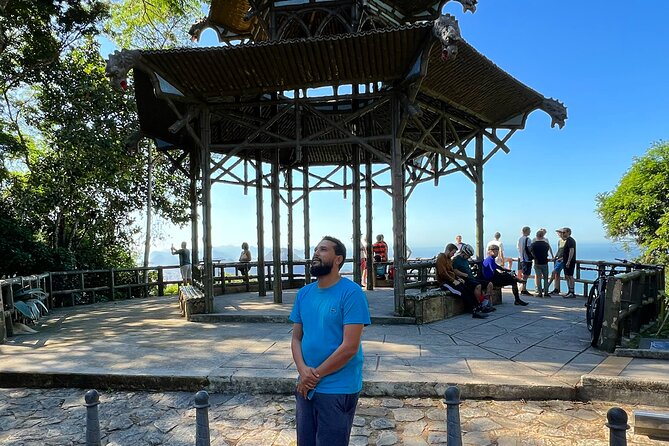
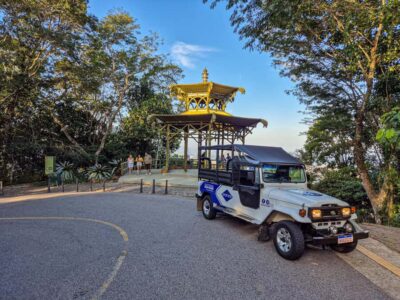
The first stop is Vista Chinesa, one of the best places to see how Rio’s forest and city fit together. From the pavilion, you look across a broad sweep of green toward the southern zone. On a clear day, the view is the sort that helps you understand Rio in one glance: forested hills, urban neighborhoods, and the city’s dramatic setting.
The pavilion was built in the early twentieth century to honor Chinese workers and the attempt to grow tea in Brazil. That story gives the stop more substance than a standard photo break. Chinese tea planters were brought to Brazil during the period connected with Dom João VI, but the crop failed. Chinese workers were later involved in road construction in the Tijuca area.
You reach the lookout by a paved route, so there is no rough trail required for the main visit. The climb by road is steep, however. If you are prone to motion sickness or simply dislike winding uphill drives, keep that in mind.
Allow about 30 minutes here. That is enough for the view, a few photos, and a short explanation from the guide. If the weather is cloudy, the forest remains attractive, but the wide city panorama can lose much of its effect.
Emperor’s Table and the road to Alto da Boa Vista

Emperor’s Table is a quieter stop, but it gives the tour its strongest historical thread. The name comes from a resting place used during walks by the imperial family. In 1856, a cantilevered road linked the Botanical Garden area with Alto da Boa Vista, helping make this forest route more accessible.
The road’s construction is tied to Chinese laborers who had originally been brought for agricultural work. When rice cultivation did not succeed, they were used in building and maintaining the route. The area also once included a building recorded as Casa dos Chinas, probably connected to this early Chinese presence.
The nearby Vista Chinesa pavilion was built in 1903 under Mayor Pereira Passos. Its design copied bamboo forms in mortar, creating the unusual structure you see today. Taken together, Vista Chinesa and Emperor’s Table show how Rio’s forest was shaped by royal leisure, city planning, foreign labor, and failed agricultural experiments.
This stop also lasts about 30 minutes. Do not expect a large museum or a formal indoor presentation. Its value is in the setting and the guide’s explanation. If you enjoy small historical details that make a place easier to understand, this is one of the tour’s best sections.
Cascatinha Taunay, Tijuca’s main waterfall
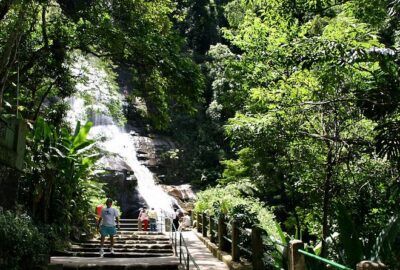
Cascatinha Taunay is the tour’s most atmospheric forest stop. Water drops through the Tijuca River, the Conde River, and other tributaries to form the highest waterfall in Tijuca National Park. A stone bridge with a Roman arch sits in front of the cascade, giving the scene a graceful man-made frame.
The waterfall is named for Nicolas Antoine Taunay, an artist who built a small home nearby in 1817. He painted the cascade and hosted gatherings for the court, becoming closely associated with the forest. His house was demolished in 1946, and an older restaurant on the site is being prepared for use as a café and restaurant.
You have about an hour here, the longest stop on the route. That extra time matters. You can take in the water, stone bridge, trees, and surrounding forest without feeling rushed. The stop is also a good place to ask your guide about Tijuca’s imperial connections and the way artists viewed the area.
The waterfall’s appearance depends on weather. A rainy period may bring stronger water flow, while dry conditions can make the cascade less dramatic. The tour itself requires good weather, and poor conditions may lead to a different date or a full refund.
Same city, a completely different kind of day:
- Rio de Janeiro: 6-Stop Highlights of Rio with Lunch
★ 4.4 · 5,157 reviews - Christ the Redeemer Entry Ticket by Corcovado Train
★ 4.4 · 4,476 reviews - Rio de Janeiro: Rocinha Favela Walking Tour with Local Guide
★ 4.8 · 3,052 reviews - Rio: Christ the Redeemer, Sugarloaf, Selaron & BBQ Lunch
★ 4.5 · 2,428 reviews
Parque Lage combines forest and old Rio
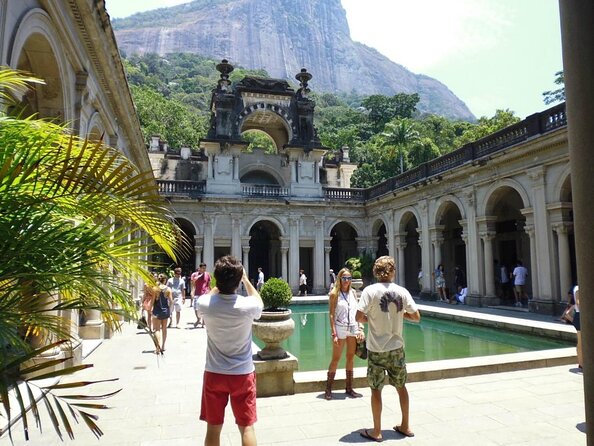
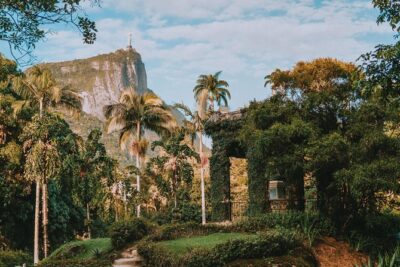
Parque Lage provides a change of pace after the forest viewpoints and waterfall. Located in the Jardim Botânico neighborhood, the park covers 52 hectares and is surrounded by Atlantic Forest. It is also part of Tijuca National Park, so you remain within the same broad natural setting while moving into a more designed and architectural space.
The old mansion is the park’s visual center. Its courtyard and setting make it a pleasant place to pause, and the guide may walk you through the surrounding forest before you stop for a drink in the building. Previous outings have included this combination of a short forest walk and time in the mansion.
I like this final stop because it gives the half-day some variety. You are not looking at one waterfall after another. Instead, you finish with trees, paths, architecture, and a neighborhood that is close to the Botanical Garden and Christ the Redeemer.
You have about 50 minutes here. That is enough to see the main area and enjoy the setting, but not enough for a long exploration of the entire park. Snacks and bottled water are not included, so bring water and budget separately for anything you want to buy.
Wildlife: keep your eyes open, but stay realistic
The tour is built around Brazilian flora and fauna in its natural setting. You are not visiting a zoo or a wildlife enclosure. Sightings depend on the day, the weather, and simple luck.
Past outings have included around 20 monkeys moving through the trees at Vista Chinesa. Toucans have also been spotted. Those are memorable possibilities, but no guide can promise them. The more useful expectation is that you will spend time in a forest where wildlife is present, even when it remains hidden.
The guide helps by pointing out what you might otherwise miss. That personal attention is one reason the smaller format matters. A guide can respond to your interests, pause for a better view, or explain the plants and animals around you instead of following a fixed script.
The strongest praise for this outing has focused on the guides’ personal attention and explanations. Ederson is named as a guide who knows the main Tijuca sights and keeps the mood relaxed. Jael and Jabier are also associated with the tour in the guide responses. Since guide assignments can change, treat those names as useful context rather than a guarantee that one particular person will lead your visit.
How the transport and group size affect value
The tour costs $88.21 per person and lasts about four hours. That is not the cheapest way to see Tijuca Forest, but the price covers a guide and vehicle, which can make sense when you value convenience and local explanation.
Transport is available for up to five people, and the total group can be as large as 14. The supplied details describe a car or jeep for groups of more than five, so confirm the vehicle before booking if your party is larger or if you want a private ride.
A small party can make this feel close to a private tour. One booking resulted in a solo outing, which allowed the guide to give a very personal experience. That format is useful if you want to ask many questions or spend more time at one viewpoint.
A group of 14 will feel different. You still avoid a huge coach, but you may have less freedom at each stop. For the best value, I would choose this tour if you are traveling with two to five people and want transport, guiding, and a carefully planned route in one purchase.
Timing, walking, and what to bring
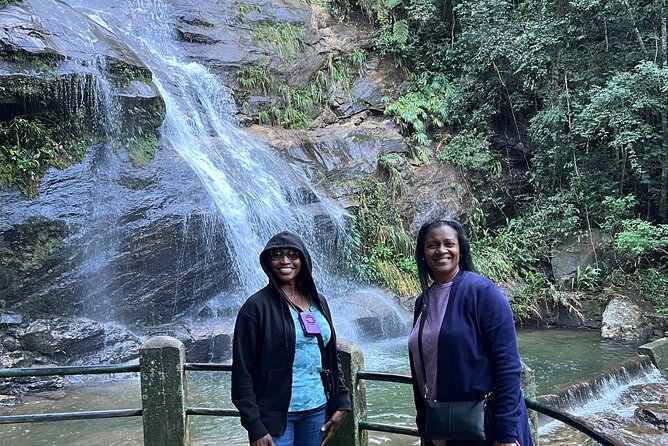
The route is more sightseeing than hiking. Vista Chinesa has an accessible paved trail, though the climb by road is demanding. Parque Lage may include a walk through the forest, and Cascatinha Taunay involves standing and walking around the waterfall and bridge area.
Most people can participate, according to the tour information, but you should be comfortable with a steep forest road and a half-day of moving between outdoor stops. Wear shoes that are suitable for walking and bring water, since bottled water is not included.
Do not plan a full meal during the four-hour outing. Snacks are also excluded. Parque Lage offers the most natural pause for a drink, but the tour does not promise a particular café service or meal.
The tour is booked an average of 25 days ahead, which suggests that advance planning is sensible. Confirmation is provided at booking. Since one date error caused a missed pickup in the past, check your confirmation and send a short message if anything looks unclear.
The cancellation rule in plain language
You can cancel up to 24 hours before the start time for a full refund. Changes made less than 24 hours before the start are not accepted, and the paid amount is not refunded.
Weather matters. If poor weather forces cancellation, you will be offered another date or a full refund. The same applies if the minimum number of participants is not reached and the operator cancels the outing.
That policy is fairly straightforward, but the 24-hour cutoff is firm. Rio’s weather can change quickly, so avoid leaving the decision until the last few hours.
Who should book this Rio nature tour?
I would recommend it to you if you want a compact introduction to Tijuca Forest with history included. It works particularly well for first-time visitors, couples, small groups, and anyone who wants to see several important sites without arranging transport independently.
It is also a good choice if wildlife interests you but you do not need a guaranteed animal encounter. Monkeys and toucans are possible bonuses, while the main rewards are the forest setting, the views, the waterfall, and Parque Lage.
I would think twice if you want a serious hike, a slow photographic outing, or a full day in one place. The schedule is designed for coverage. You see four distinct stops, but none receives the time that it would on a dedicated walking tour.
Should you book it?
Book this tour if you want four strong Rio sights in one half-day, with a guide to connect the forest to Chinese tea cultivation, imperial roads, artists, and urban history. The combination of Vista Chinesa, Emperor’s Table, Cascatinha Taunay, and Parque Lage gives you more variety than a simple viewpoint excursion.
At $88.21, the value depends on your group size and your need for transport. For a small party that wants a personal guide and an easy route through Tijuca, it is a sensible choice. Confirm the date, vehicle, pickup details, and guide assignment before paying, then bring water and leave room in your schedule for the view at Vista Chinesa.
FAQ
How long does the Tijuca Forest tour last?
The tour lasts approximately four hours.
How much does the experience cost?
The listed price is $88.21 per person.
Which places are included?
The route includes Vista Chinesa, Emperor’s Table, Cascatinha Taunay, and Parque Lage.
Is Horto Waterfall included?
Horto Waterfall appears in the experience title, but the supplied stop details do not describe a separate visit there. Confirm this point with Trip In Rio before booking.
Is transport provided?
Yes. The experience includes a guide and transport by car or jeep. The details mention transport for groups of more than five, so confirm the vehicle arrangement for your party.
How many people can join?
The maximum group size is 14 people.
Is bottled water included?
No. Bottled water and snacks are not included.
Can most people take part?
The activity information says most people can participate. The route includes a steep climb by road and outdoor walking around the forest, waterfall, and park.
Can I cancel for a full refund?
Yes. You must cancel at least 24 hours before the experience start time for a full refund. Poor weather or failure to meet the minimum number of participants may also result in a new date or full refund.
Just added around Rio de Janeiro
- Vidigal Favela Tour★ 4.4 · 26 reviews
- Hang gliding flight in Rio de Janeiro★ 5.0 · 6 reviews
- Rio de Janeiro: Zip Lining and Canopy Tree Tour★ 3.3 · 6 reviews
- Tijuca Forest Hike – Waterfalls & Caves, Nature & Wild Life!★ 5.0 · 51 reviews
- Unforgettable Boat Party★ 5.0 · 3 reviews
- Guided Tour to Favela Santa Marta★ 5.0 · 60 reviews
- Rio de Janeiro: Attend a Vasco da Gama game with local guide★ 4.8 · 9 reviews
- Rio Highlights: Christ, Sugarloaf, and More in a Private Tour★ 5.0 · 36 reviews
Tijuca Forest Tours, compared.

Jeep Adventure: Guided Tour through Tijuca Rain Forest
Read our review →
Tijuca Forest Small Group Hike to Caves and Waterfalls
Read our review →
Rio de Janeiro Botanical Garden & Tijuca Forest Tour
Read our review →
Browse the lists this tour appears in